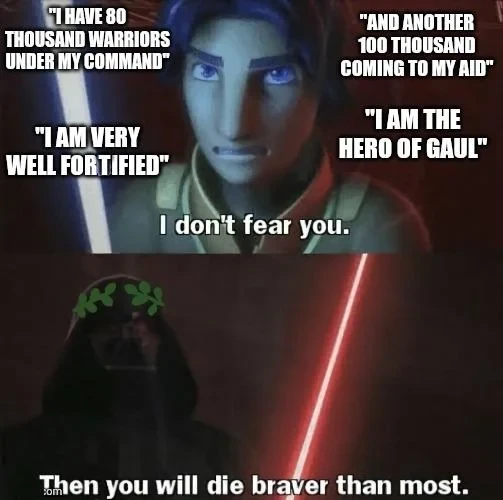

Explanation: In the Siege of Alesia during the Gallic Wars of Julius Caesar (of conqueror and dictator fame), Caesar, with a force of about 50,000 Roman and allied troops encircled a slightly largely force under Vercingetorix in the fortified city of Alesia. Caesar, in order to ensure none of the Gauls could escape to regroup, built a wall around the fortified town. Vercingetorix was a charismatic and skilled Gallic warlord who sought to expel the Roman intruders from Gaul, after several years of the Romans increasingly intervening in inter-tribal wars and making themselves increasingly ‘at home’ as overlords of Gallic polities.
Vercingetorix, however, had planned to be surrounded - he had sent out the call for a much larger force to gather and surround Caesar while he was surrounding Vercingetorix!
Caesar played the Uno Reverse card, and built a wall around the wall he was using to surround the walled city of Alesia. That’s three (3) walls in total, for those counting, two by Caesar, one by the Gauls. So when the massive Gallic relief force arrived, they found out that there was no fair fight to be had - they had to siege out Caesar’s own besieging force to rescue Vercingetorix! To make matters worse for them, Caesar had his men ransack the countryside for all available food, burning what they couldn’t take - meaning the relief force couldn’t linger for long without starving.
By Caesar’s counting, he faced nearly ~350,000 Gallic warriors in total. It was likely significantly less than this, with the number exaggerated for both practical (hard to count an enemy hemming you in while you hem them in) and propaganda (big numbers = big victory) reasons. Modern figures range from ~80,000-200,000 enemy troops against Caesar.
Forced into several costly assaults on the Roman walls by their circumstances, the Gauls, even coordinating between the besieging and besieged forces to time their attacks, were driven back, and Vercingetorix eventually surrendered for lack of supplies (and lack of ability to break out of Caesar’s siege), ending the Gallic Wars with one of Caesar’s greatest victories.
@PugJesus Also partly why history is so interesting to read. Real-life stories rarely make much sense objectively, and the bold choices of the winners can be fascinating.
One thing that always stuck with me is that almost all successful figures in history are gamblers to some degree.
Or as Caesar himself said, "Alea iacta est!" - “The die is cast!”
Did being gamblers make them successful, or just memorable?
Nobody cares about all the times Goliath won, after all.
Perhaps those who risk much are more likely to either win big or lose big, and then there’s a huge selection bias for which we hear about later in life/history…
That’s actually a very interesting question. Caesar was known for his luck throughout his life, and it certainly led to him having a larger appetite for risk than his contemporaries. But a lot of that luck was also created by him being incredibly skilled at just about anything.
Another commander known for his luck, and gambles, was Napoleon. This worked out incredibly well for him (well, for a time anyway). He equally was incredibly skilled at just about anything he set his mind to and both were tireless workers.
Gambling like that is something you can do when you are confident that whatever situation you get yourself in, you’ll be able to work your way out of it. Both got into very dicey situations at times. They had the skillset and the highly disciplined troops to work themselves out of these situations (example: Napoleon losing the first battle of Marengo, realizing there was still time for a second battle and crushing the celebrating Austrians. Another example: Caesar at the battle of the Sabis managing to rally his troops after being ambushed and eventually being able to push back the Nervii. Both turned out to be crushing victories where they really should have lost.)
If you don’t take great risks, you don’t get great rewards.
If you don’t get great rewards, someone else will gamble on them.
If someone else gambles on great rewards and wins… you may be in a position where you are no longer a great risk to them, and can be crushed/kept from successes without any great gamble.
Self-feeding, I think.
@PugJesus It’s true. No risk. No reward.