
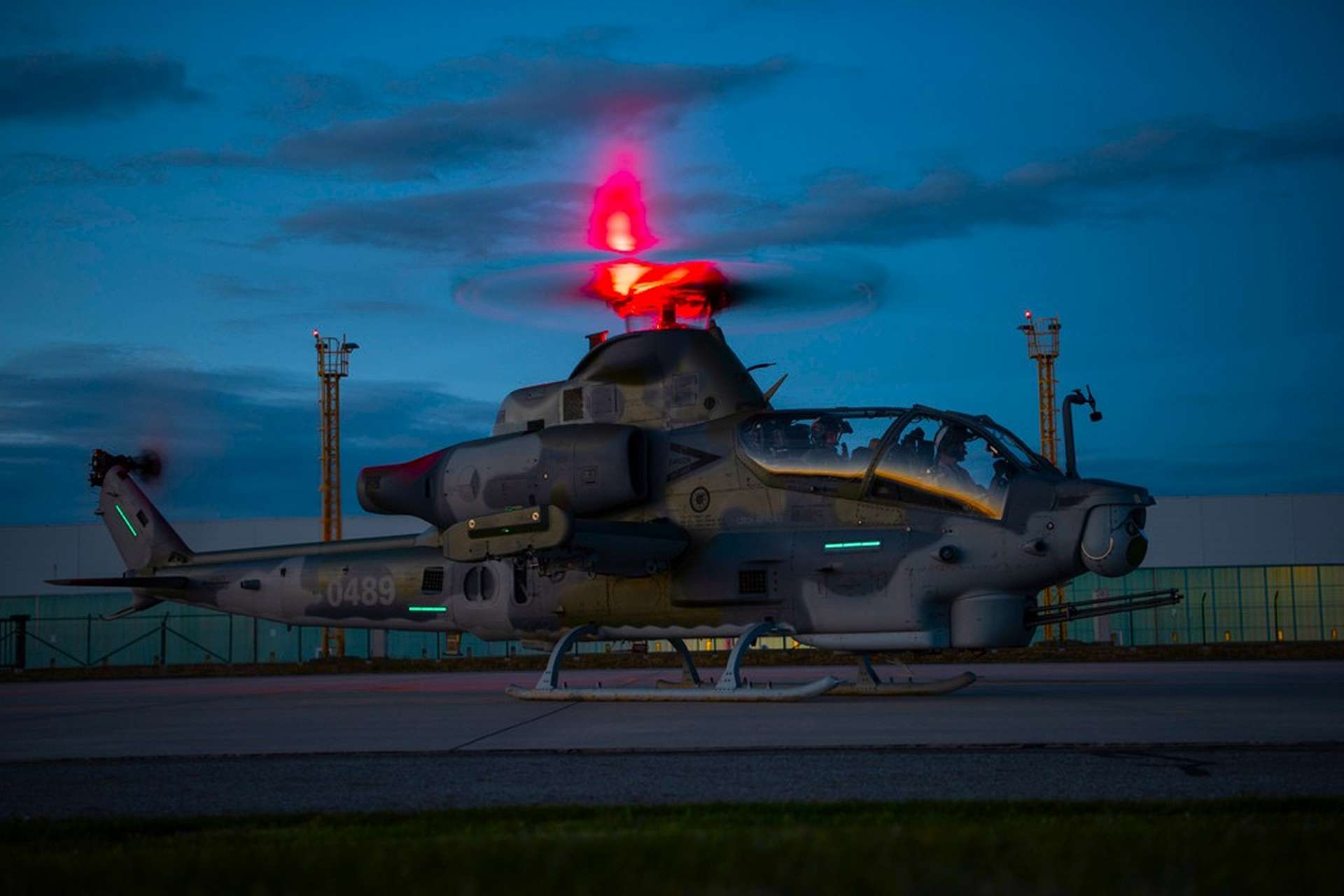
The Czech Vipers will continue the work already carried out by Czech helicopter crews in Poland. The Czech Republic redeployed a helicopter unit at the request of the Polish Armed Forces in September 2025, shortly after Russian unmanned aerial systems penetrated Polish territory. Since that incident, Czech helicopter crews have introduced procedures for countering low-flying targets into their training curriculum, with emphasis on Counter Unmanned Aerial Systems missions. This operational adjustment reflects the changing air threat around NATO borders, where drones, loitering munitions, and other low-altitude platforms can challenge conventional surveillance and air defense networks.
The unit’s main task will be to operate against low-flying targets. In military terms, this mission places the AH-1Z Viper at the tactical interface between airspace surveillance, armed reconnaissance, and local air defense support. Attack helicopters cannot replace fighter aircraft or ground-based air defense systems, but they can provide mobile coverage, visual identification, and rapid engagement options in areas where terrain, altitude, radar coverage, or rules of engagement make interception more complex. In Poland, this gives NATO and Polish forces an additional tool against slow, low-altitude, or ambiguous aerial threats.
Take note of the entrance of the AH-1Z into the European theater here.
If there is one platform that can decisively end the Ukraine War it is the H-1 helicopter. There is no other platform more well suited to air defense against mass waves of flying bombs, that can be anywhere and rearm/refuel anywhere and can serve a variety of other uses including launching long range strike munitions itself.
If the Mi-24 Hind is a flying tank, the AH-1Z is a dancing one, the maneuverability, sensors and pure payload capacity place the AH-1Z in a nearly ideal intersection of attributes to be effective as an “air defense goalie” coordinating layered air defense while executing air defense missions itself.
Jet powered flying bombs with automated targeting obviously pose a threat, but note that the AH-1Z and previous iterations have been able to carry and fire AA missiles capable of destroying fighter jets for decades, the capability of an attack helicopter with a mounted millimeter wave radar like the Longbow radar to hide in terrain and pop out to launch Air to Air missiles is just as if not more decisive than the capability to use such tactics on ground targets, it is just up until now there hasn’t been a need.
https://www.youtube.com/watch?v=EGpdX4MPcy4
Video from inside cockpit of AH-1Z so you can get an idea of how agile the platform is.
Recent footage of a UH-1Y & AH-1Z pair flying in close formation tight to the ground.