

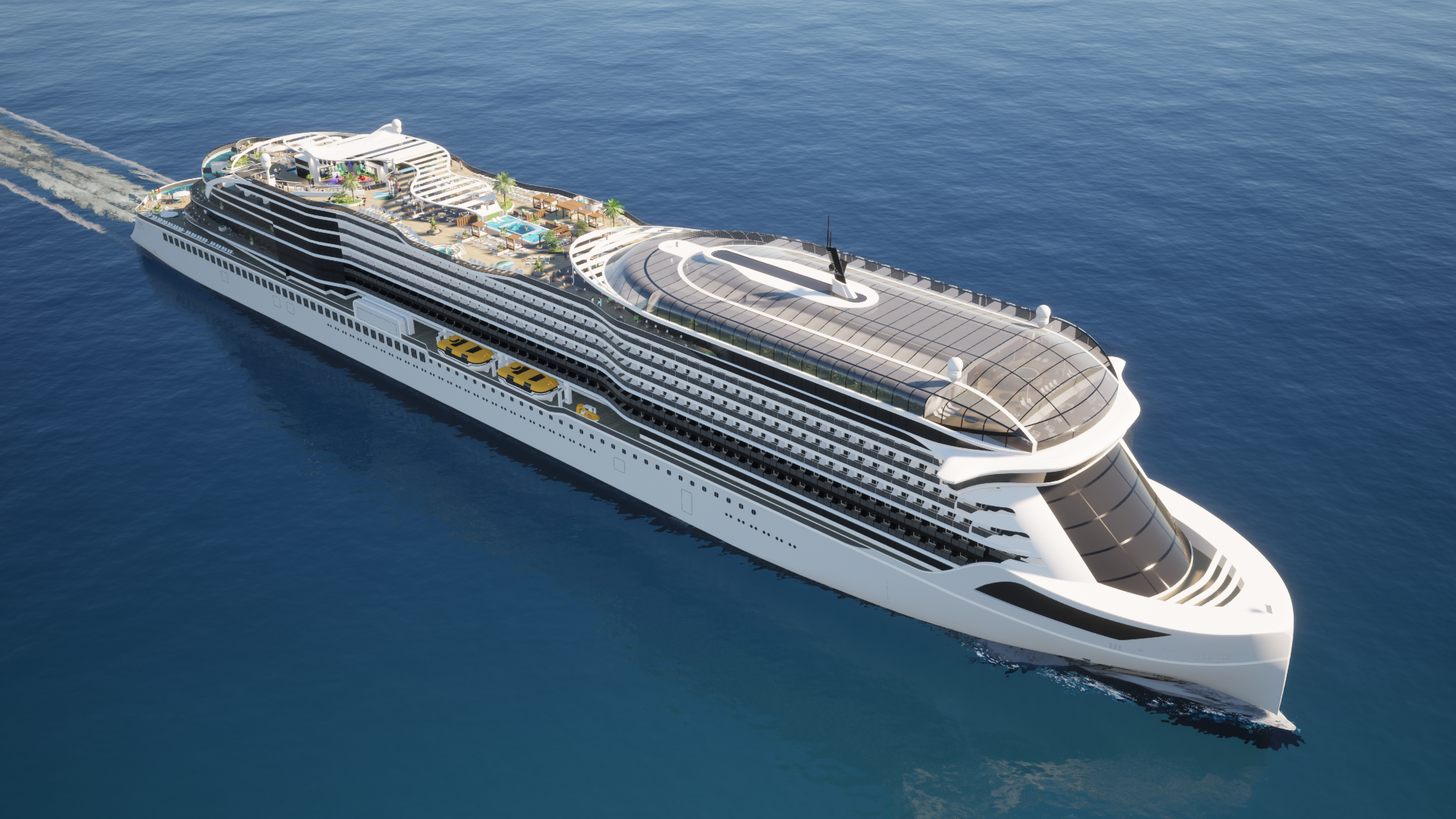
The company has not disclosed the exact battery capacity or operating range.
Meyer Werft noted that the ship can also be built as a hybrid with small generators to enable longer routes, including transatlantic crossings.
Ok. Sure.
Most of the time a cruise ship is only going to move as far as it can get in a night. The sales pitch is you get to see a different city every day. There are a few places where the ship wants to be during the day (some glaciers are beautiful from the sea), but most of the time the customers plan on walking on dry land every single day, just in a different city. Thus they only need enough to get to the next port. Most transatlantic cruises sell at a large discounts because most people find the idea of spending a week on a ship not interesting (there are exceptions).
As such it is believable that most cruise ships could run on battery most of the time, and only need generators for crossing the ocean. That is very different from your typical cargo ship that is crossing the ocean on every trip and so needs a lot more energy. Of course believable is very different from reality, batteries are not very energy dense, and so it isn’t clear if it really can work or if this is a press release that will fail when real engineers (or the real world) get involved.
It’s just a concept. If someone is interested they’ll start thinking more about it.
But reality is hard against this to work. I don’t see ports having the electrical power to charge the batteries, and ships don’t generally have a use case for charging the batteries on diesel.
Single use would be trying to market “green” whale watching ships or “emission free port call” to ease getting autorisation with touristic cities closing in on port air pollution.
Power to ports is the least of my worry - that is cheap to build compared to all the other costs.
Charging on diesel doesn’t make sense though. It makes more sense to have a ‘tug boat’ with engines for those trips and then it can do something else (what?). Can an existing ship (either cruise or cargo) tow this across the ocean on need?
in the end though my question is can batteries large enough fit on a ship. Everything else is logistict we can figure out but batteries are not energy dense. Ships have a lot of space (and need ballest weight on the bottom), but is there enough?
I’m sure every port has a 100KW DC line just ready to hook up.
industry forecasts indicate that roughly 100 European ports will have the necessary charging infrastructure by 2030.
Industry forecasts are going to be overestimating it. They want people to buy these ships based on their made up numbers. Wake me up when it’s ready.
This comm is ‘futurology’, if you don’t like dreaming about what might happen, perhaps this isn’t the comm for you.
Fair
Yeah. That’s where the tech is needed the most. It’ll do the most good there, yep.
We’re so fucked as a species.
Those ships typically burn bunker fuel, it’s nasty stuff.
How is this not a good thing?
Because it’s a lie? 🤌🏼 🤷🏽♂️
Care to explain?
Sorry, is this not showing at the top for you?
Are they gonna stop dragging anchor through reefs?
Or dumping waste straight into the water?
Fish shit in the ocean, why can’t I?
But if the batteries get wet they’ll electrocute the sharks!
Don’t worry, that’ll just energize their latent powers. 🤘🏻