
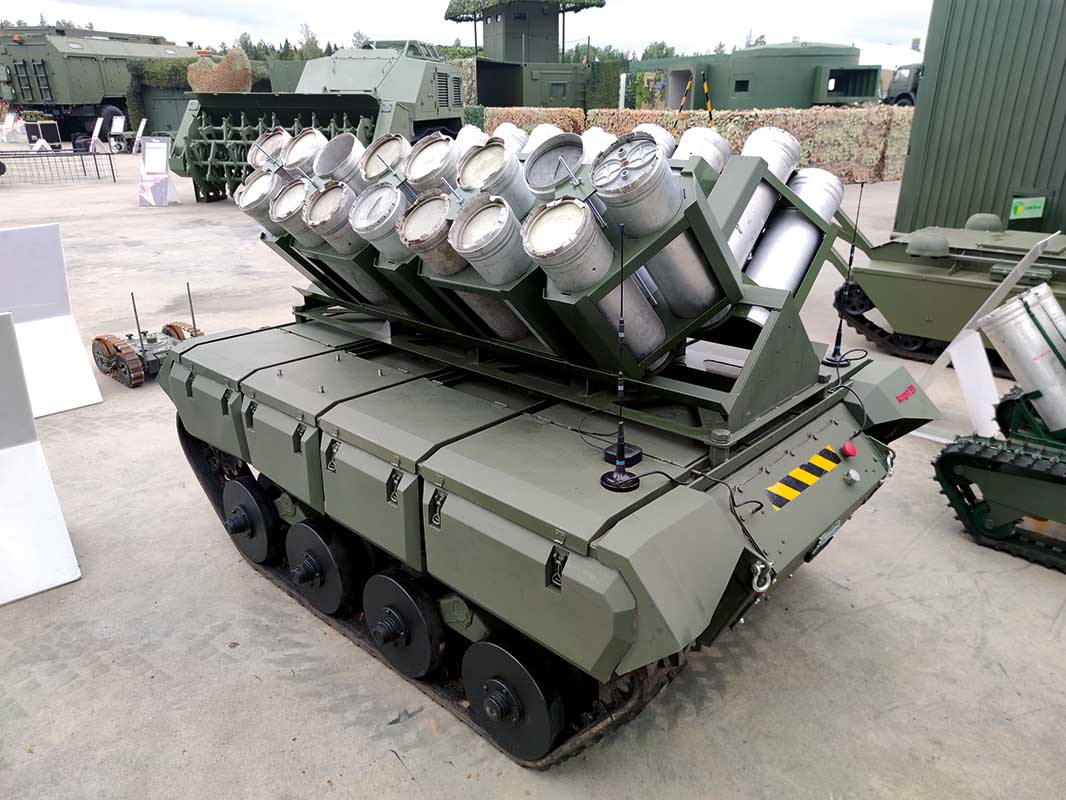
Over recent years, both Russia and Ukraine have invested heavily in UGV technology, resulting – by early 2026 – in a surge in deployed systems and an expansion of their combat and support roles. In March 2025, Ukrainian news outlets, citing a Ministry of Defence official, reported that the Ukrainian military planned to deliver over 15,000 UGVs by the end of 2025. This represents 7.5 times the estimated 2,000 UGVs produced in 2024 (a 650% increase). While the Russian Ministry of Defence and military industry officials do not disclose precise figures, Russia appears to be following a similar trajectory, with more systems entering low-rate serial production, experimental combat employment, and field-testing.
Ukraine and Russia exemplify a broader global trend toward autonomous ground systems. The military UGV market is expected to grow from USD 3.07 billion in 2024 to USD 6.35 billion by 2032, at a Compound Annual Growth Rate (CAGR) of 8.6%. Arguably, the most significant consequence of this wider adoption and combat use is the emergence of new applications for autonomous systems, alongside the validation of older concepts.
Before examining specific cases in detail, it is necessary to note that changes in contemporary warfare have brought to the fore several key challenges and debates surrounding the development and employment of unmanned ground systems. Unlike the air and maritime domains, the land domain has proven to be, and remains, the most challenging environment for robotic systems, with ground combat representing the most complex operating conditions. Despite recent advancements, many of these difficulties remain unresolved and have been further intensified by evolving battlefield dynamics.
You must log in or # to comment.