
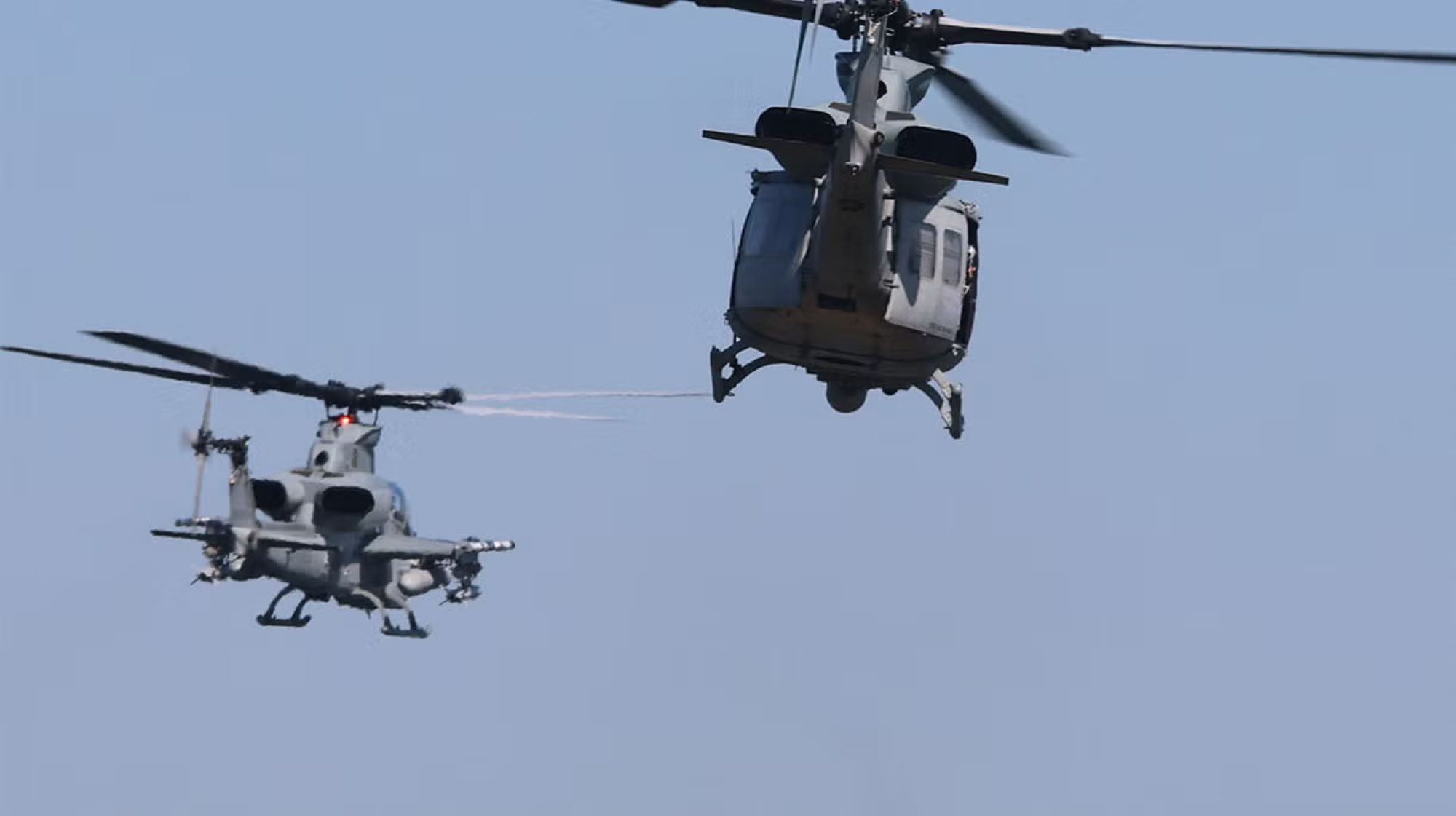
L3Harris’ current statement said the Red Wolf, “mounted to the pylon of an AH-1Z Viper helicopter […] successfully launched and engaged a sea-based target” as a part of the LRAM capability demonstration, while also participating “in the targeting network, highlighting its operational relevance.” As we had noted before, this is consistent with previous Marine Corps’ drills with AGM-179 JAGM missiles fired from AH-1Z Vipers against a maritime target in the Indo-Pacific and L3Harris’ concept videos showing the Red Wolf striking the main sensor mast of a PLA Navy Type 52D destroyer.
The goal might be to temporarily blind the ship’s main sensors and open the doorway for larger follow-on strikes by AGM-158C LRASM (Long-Range Anti-Ship Missile) or the Joint Strike Missile (JSM). L3Harris’ president of space and airborne systems Ed Zoiss said the test “validated Red Wolf’s advanced tracking and targeting capabilities, further demonstrating its ease of use and integration across platforms.”
Red Wolf sits at the heart of L3Harris’ “wolf pack” family of launched-effects vehicles, which also includes the Green Wolf electronic-warfare variant. The family is designed as a set of modular, mini cruise missiles that can be fired from air, ground or maritime platforms and then collaborate in flight to sense, jam, deceive and strike targets on land or at sea.
Red Wolf itself is the kinetic element of this pack: a high-subsonic, long-range precision strike weapon with a quoted range of more than 200 nautical miles and, in some descriptions, up to 375 km depending on profile. Its architecture is built around fold-out wings and fins for stability, a cruise engine for sustained flight and a modular payload section able to accept different warhead types and seeker combinations, including GPS, infrared and radio-frequency guidance for both line-of-sight and non-line-of-sight engagements.
At software level, the wolf pack concept emphasises in-flight retargeting, machine-to-machine collaboration and swarming behaviour, with options for parachute recovery and refurbishment when the mission profile allows, aiming to balance performance and cost over the life cycle.