I mean it was a famine but only because of an overreliance on one specific crop, due to sociopolitical reasons
Normally if one crop fails due to a disease, it won’t result in a full-scale famine. Most historical famines are caused by wider climate and weather patterns
So to call it a famine is a little disingenuous, even if its technically accurate
Yeah that’s fair. Perhaps my objection is really that the word ‘famine’ spanning both environmental and man-made food shortages can blur the issue generally.
Like, aside from a few relatively brief famines exacerbated by war, the Irish Famine is pretty much the first ‘artifical’ famine historically. It’s not until the 20th Century that these become common
So you’re right, but the term ‘famine’ definitely gets used to imply something natural and unavoidable, particularly in the 19th Century


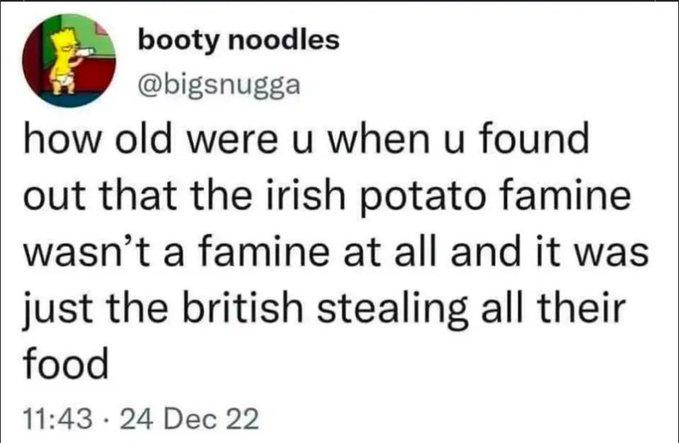
Whatever the reason, it was a famine, a wide spread scarcity of food.
Look the definition up.
I mean it was a famine but only because of an overreliance on one specific crop, due to sociopolitical reasons
Normally if one crop fails due to a disease, it won’t result in a full-scale famine. Most historical famines are caused by wider climate and weather patterns
So to call it a famine is a little disingenuous, even if its technically accurate
So how about Holodomor?
Yeah that’s fair. Perhaps my objection is really that the word ‘famine’ spanning both environmental and man-made food shortages can blur the issue generally.
Like, aside from a few relatively brief famines exacerbated by war, the Irish Famine is pretty much the first ‘artifical’ famine historically. It’s not until the 20th Century that these become common
So you’re right, but the term ‘famine’ definitely gets used to imply something natural and unavoidable, particularly in the 19th Century
Yes. People tend to use it as if it was some natural or biblical born disaster.
But no.
Famine is descriptive word for outcome of mechanics in play to produce scarcity of food.
It literally means hunger.
You can call a genocide a depopulation, which is true, but omits important context.